

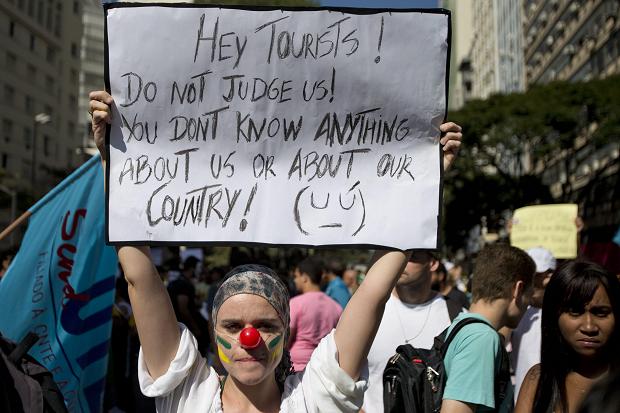
 Recent protests in Brazil and Turkey have one major thing in common: they both started out small, sparked by seemingly insignificant events, were reacted to by unnecessary police force, and for that reason, quickly spiralled into mass demonstrations against a broad spectrum of grievances.
On May 28 about 100 activists began a sit-in in Gezi Park, protesting Turkish Prime Minister Recep Tayyip Erdogan´s decision to tear it down and build a shopping mall. The announcement, though generally unpopular among Turks, had not garnered much of a reaction, and the protesters, by all accounts, were peaceful.
Then came the police.
An intense and unexpected crackdown included the use of used tear gas and water cannons to force the peaceful activists out of the area. Within about a week, Turks of all socio-economic statuses and religions began protesting in 48 cities across the country, infuriated by the needless police brutality. The majority of these protests were peaceful, even joyous occasions where vendors sold home-made goods… unless police decided to end the protests.
About a week later, on June 6, a similarly small group in Brazil protested against a 10% increase on the public transport fares. On June 13th military police, many with their name tags removed, converged as the crowd, firing stun grenades and rubber bullets. This escalated into nation-wide protests against a broad spectrum of grievances, including police violence, a long-standing problem in Brazil.
Here is where the parallels end.
In Brazil, while grievances were largely directed toward government corruption as a whole (and as a by-product Dilma Rousseff´s popularity ratings have suffered) Turkish protests were aimed directly at Erdogan´s authoritarian behavior. Rouseff immediately condemned police brutality while Erdogan excused it and even said it was necessary.
In Brazil, timing of the protests happened to coincide with preparation for the Confederations Cup, so one of the major grievances became the exorbitant costs of preparation for two of the World´s major sporting events, the World Cup in 2014 and the Olympics in 2016. What had originally been seen as a boon for foreign investment in Brazil was suddenly seen as a complete waste of resources.
It remains to be seen if either movement will maintain fervor. Reportedly, over 70% of marchers were first-time protesters. Many in Brazil say they will keep up their efforts until the World Cup, but given their impressive Confederations Cup victory over Spain, protests will likely turn in to ebullient celebrations.
In Turkey, many feel that the high rate of first-time protesters in a society that has largely refrained from that type of demonstration is a victory in and of itself. A line in the sand has been drawn, and Erdogan put on warning how far he can push his conservative agenda. Turkey is, after all, a secular society, and for the time being it seems that kissing in the subway will continue. However, Erdogan was just re-elected for another six year term, and the chances of his going the way of Mohamed Morsi in Egypt have passed.
Less Good: Unfortunately, numerous tag-on items to each protest movement, from anti-abortion sentiments to employment concerns detracted from credibility. While a small base will remain interested in the basic anti-corruption and police brutality causes, protests on such a massive scale are not likely to happen again.
The more important take-away in both cases, is that Brazilian and Turkish societies showed that they are not apathetic or willing to accept status quo, and will voice discontent peacefully: that is a resounding success.
 Spanglish Observer