
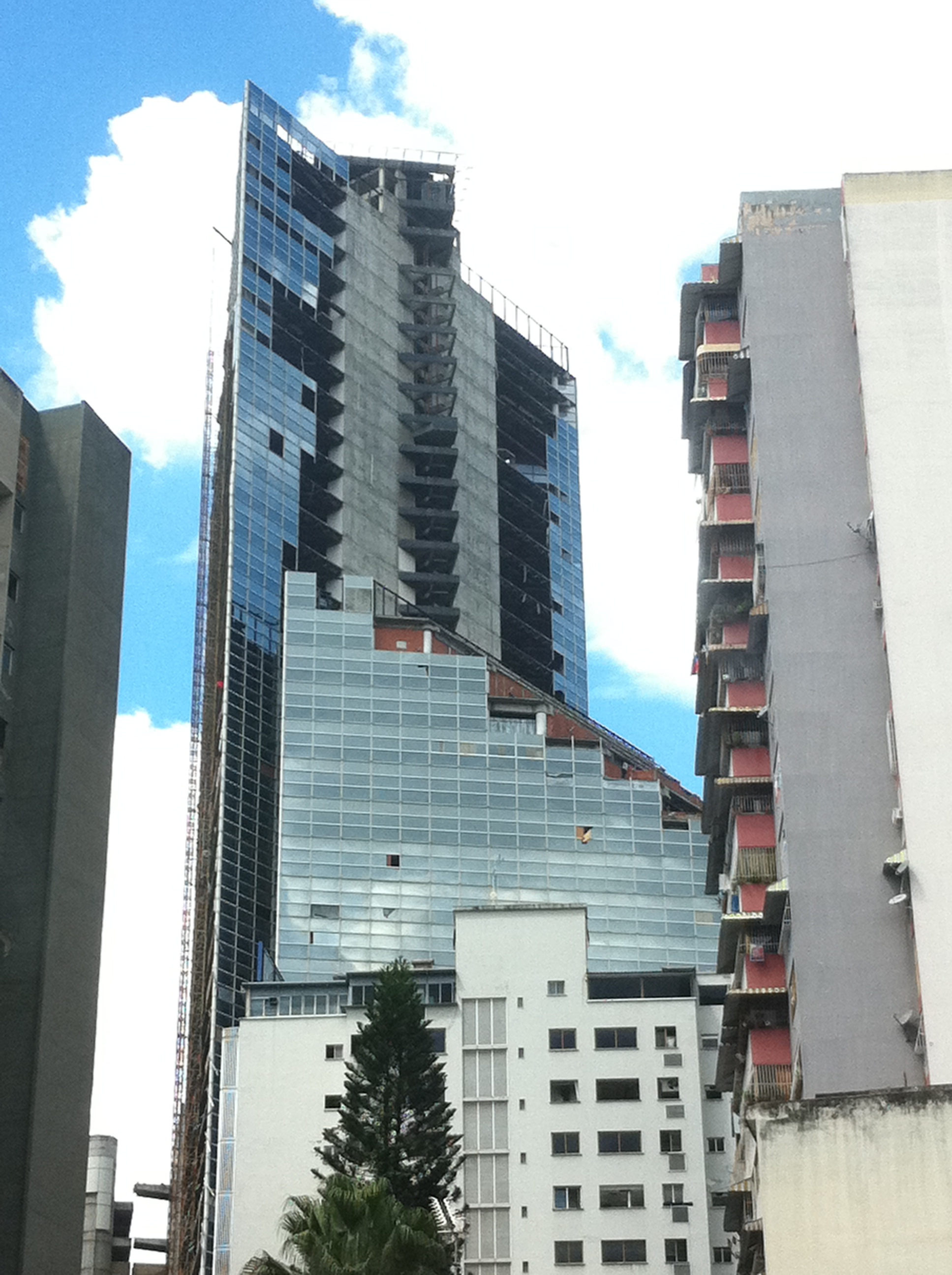
 Pictured is the world’s tallest slum, La Torre de David in Caracas, Venezuela. In 1994, lack of funds halted construction of what was supposed to be one of Latin America’s most important banks, complete with helipad. In 2007 squatters invaded the vacant building. Today some 2,500 people live there. La Torre de David is the incomprehensible… a physical manifestation of the country’s riches to rags story.
Throughout October I listened to musings about how Venezuelans got to this point – the point where a squatter takeover of a new bank building is normal, or the nonchalant acceptance that going out after sunset (6 pm) means you may very well get mugged.
How was it possible that after an influx of thousands of voters returned to the country (most likely returning to vote for a change) Hugo Chavez still won re-election on October 6?
Three basic theories prevail. The first being that “no hubo fraude, pero si hubo trampa.” Examples are endless, so just a few of the most glaring will suffice.
– Opposition candidate Henrique Capriles was limited to three minutes of TV commercials per channel per day, Chavez had unlimited airtime.
– Part of the Chavez campaign was the promise to provide free or subsidized housing to more than three million families.
– Thousands of Cubans, Bolivians and even Chinese expats brought to the country by the government were given voter registration cards.
– Finally, and possibly the most important fact, is that on Election Day, from 6am – 2pm Capriles had a hefty lead in the polls. At approximately 2pm government vans were dispatched to viviendas (government-paid housing) to remind people who had not yet voted that it was Election Day. If you had avoided going to the polls and a government van told you to get in and vote, for whom would you vote?
The second camp decries all of these points as whining and says the election was won – fairly. Chavez represents, for many, a change in the Venezuelan discourse. Being part of the población was no longer a source of embarrassment, but pride. The country worked to serve the needs of the poor, not the rich. Various Chavistas said that no matter how hard Capriles tried, there was still something they did not trust about him. Call it reverse classism, call it reverse racism, the bottom line remains the same: no matter how likeable, this opposition candidate bore the stigma of the elite.
Finally the third, and likely correct camp, believes both. Yes, there likely were more people at Capriles’ campaigns, and photos of Chavez campaign rallies probably did have photo-shopped little images of red-clad bodies. Yes, there were Cubans, Bolivians and even Chinese who were given voter cards with the purpose of swelling the coffers, and yes, that 2-6 pm vote surge is highly suspicious. And yet, a critical mass of Venezuelans still do not trust the opposition. In a country polarized by classism, memories of a forced inferiority have not yet faded, and for the millions who live below the poverty line, the fact that they are still below the poverty line does not matter so much as the fact that the man in charge gives them a voice, and he reminds them every day that he is fighting for him.
Now, the question is not how did we get here, but how do we get out? Those that gave up on the country are long gone. They’ve opened businesses in Bogota and Panama City, or have cloaked themselves in Louis Vuitton in Miami. But many have stayed, and more importantly many returned for these elections. After licking their wounds they are focused on the next round. The December 16 gubernatorial elections are just a few weeks away and opposition politicians are hoping for a strong showing to limit the reaches of Chavez’ power.
In some ways, the Torre and dozens of other invaded buildings demonstrate both the power and debility of the juggernaut that is Hugo Chavez. There may not be running water or electricity, but at least the rent is… free.
 Spanglish Observer